
In this guide
What Is White Label SEO?
White label SEO is a business arrangement in which a specialist SEO provider delivers search engine optimization services that another company — typically a digital marketing agency — rebrands and resells under its own name. The end client never knows a third party is involved.
The model is also called SEO reselling or private label SEO. The terminology differs, but the mechanics are identical: one company executes the SEO work; another presents that work to clients as its own.
Think of a coffee shop that sells house-blend beans under its own label, sourced from a specialist roaster the customer never meets. Your agency is the coffee shop. The white label provider is the roaster. Every deliverable — audits, reports, content, link-building campaigns — arrives branded with your logo, on your domain, under your agency’s name.
In 2026, white-label SEO has moved well beyond a fallback option for stretched agencies. It is now a core growth model for digital businesses of every size — driven by rising client expectations, increasingly complex SEO requirements, and the prohibitive cost of building and maintaining a full in-house SEO team.
What white label SEO is not: it is not a loophole, not a black-hat shortcut, and not outsourcing to low-quality offshore farms. Done properly, it is a structured operational model governed by a formal agreement, measured by real results, and built on the same principles as any other managed service partnership.
How White Label SEO Works: The 4-Step Workflow
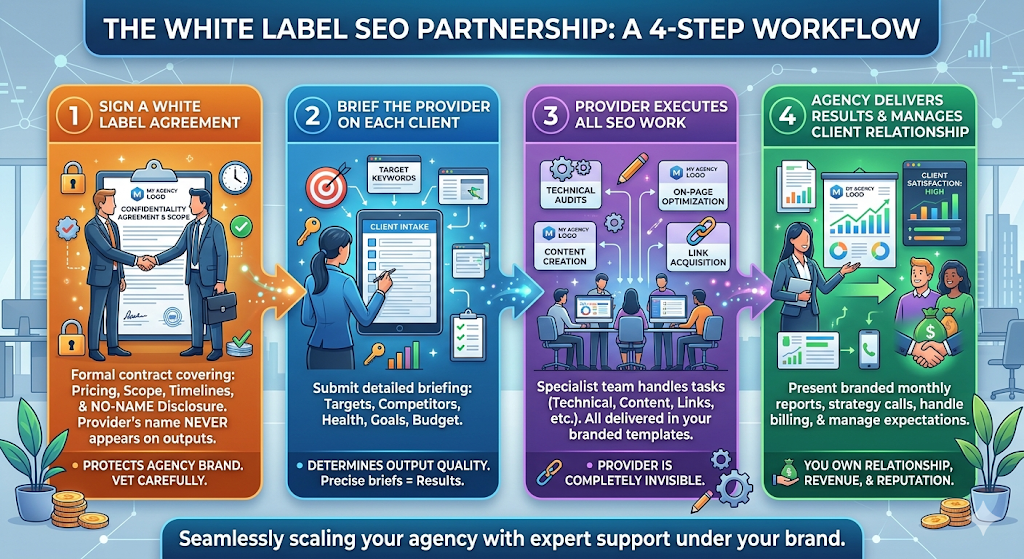
This is the most searched sub-topic for “what is white label SEO,” and the section most articles either omit or underserve. Here is the complete operational workflow, from first contact to ongoing delivery.
- Sign a white-label agreement. Before any work begins, the agency and provider execute a formal contract covering pricing, deliverable scope, turnaround times, revision policy, and — non-negotiably — a confidentiality clause. The provider’s name must never appear on any client-facing output, dashboard, or email. This legally protects your agency brand. Vet this document as carefully as you would a senior hire’s employment contract.
- Brief the provider on each client. The agency submits a detailed client intake document: target keywords, competitor URLs, current site health, any past penalties, content goals, timeline, and budget. The quality of this briefing is the single largest determinant of output quality. A weak brief produces generic SEO. A precise brief produces results.
- Provider executes all SEO work. The provider’s specialist team handles technical audits, on-page optimization, content creation and editing, link acquisition, local SEO tasks, schema markup, and performance monitoring — all delivered in your branded templates. Your agency’s logo, domain, and contact details appear on everything. The provider is completely invisible.
- The agency delivers results and manages the client relationship. You present branded monthly reports, hold strategy calls, handle billing, and manage client expectations. The provider remains invisible. From your client’s perspective, your agency executed every tactic. You own the relationship, the revenue, and the reputation.
Key insight
The agency is the relationship layer. The provider is the execution layer. Success depends on keeping communication fast, briefs detailed, and reporting transparently — on both sides of the arrangement.
Services That Can Be White-Labelled
A comprehensive white-label SEO engagement in 2026 should cover all of the following pillars. If a provider cannot demonstrate depth across each area, treat that gap as a meaningful red flag.
Technical SEO
Full site audits covering crawl errors, indexation issues, duplicate content, URL structure, internal linking, structured data (schema markup), page speed, Core Web Vitals compliance, mobile usability, and XML sitemap management. In 2026, the critical Core Web Vitals benchmark is Interaction to Next Paint (INP), which replaced First Input Delay as a ranking signal. Technical SEO is the foundation — weak technical health limits what content and links can achieve.
On-page SEO and content optimization
Keyword research, content gap analysis, title tag and meta description optimization, header hierarchy, image alt text, semantic keyword integration, and content benchmarked against current SERP competitors. Quality providers in 2026 build content strategies around E-E-A-T: demonstrable author credentials, first-person expertise signals, and original data — not AI-generated filler that invites manual penalties.
Link building and off-page authority
Ethical outreach-based link acquisition, digital PR placements, broken-link reclamation, and unlinked brand mention campaigns. Ask every provider directly about their link-building methodology before signing. Tactics that were safe in 2022 carry significant risk today. Insist on white-hat methods only, with full visibility into target sites and outreach approaches.
Local SEO
Google Business Profile optimization, review strategy, geo-targeted content creation, NAP accuracy management, and local citation building. The local SEO software market is projected to grow from $6.75 billion in 2023 to nearly $21 billion by 2032 — making it one of the highest-demand service categories for agencies serving brick-and-mortar businesses, law firms, medical practices, and restaurants.
eCommerce SEO
Product page optimization, category architecture, structured data for product schema, faceted navigation management, and site speed optimization for large catalogues. eCommerce SEO requires a distinct technical skillset most generalist providers lack — verify capability with concrete case studies before committing.
GEO and AI Overviews optimization
The fastest-growing white-label service category in 2026. See the dedicated section below for the full breakdown — this is where your competitive moat lies.
White-labeled reporting and dashboards
Branded monthly performance decks, real-time ranking dashboards, and client-accessible reporting portals — all stripped of the provider’s branding and delivered under your agency identity. Reporting quality is the #1 client retention lever. See the reporting section below for what good looks like.
Who Uses White Label SEO?
Most white-label SEO content focuses exclusively on “agencies.” But the model fits a much broader range of business types — and understanding that breadth helps you identify whether it is right for your situation.
- Digital marketing agencies that want to add or expand SEO without hiring in-house specialists.
- Web design and development studios that build sites but have no organic growth offering — white-label SEO lets them retain clients post-launch.
- PPC and paid media agencies are diversifying into organic channels without building a new team from scratch.
- PR and communications firms that want to offer digital visibility services alongside traditional media coverage.
- Social media agencies are extending into search as clients increasingly demand full-funnel digital strategies.
- Freelance consultants who manage client relationships but want to offer enterprise-level SEO execution beyond what one person can deliver alone.
- SaaS and software companies that need SEO for their own properties but cannot justify a full in-house team at an early or mid-stage.
Why Agencies Use White Label SEO in 2026
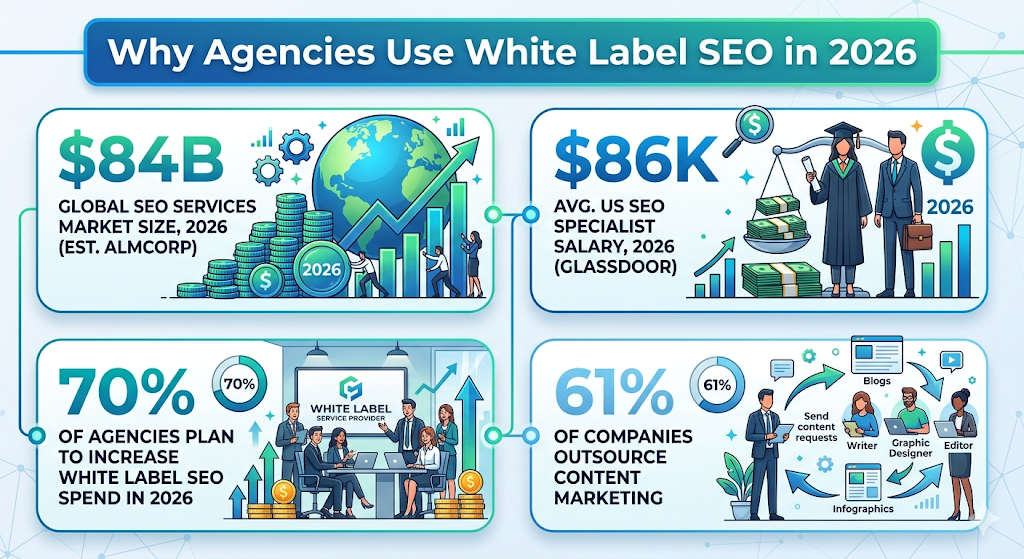
Updated salary data (2026): The average SEO specialist salary in the United States is $85,999/year per Glassdoor data from March 2026, based on 3,442 anonymously submitted salaries. The range runs from $65,263 (25th percentile) to $114,128 (75th percentile). Senior SEO specialists average $104,103/year. Source: Glassdoor, March 2026. Note: the previously cited $60,000 figure reflected 2021–2022 data and is now significantly outdated.
Build a complete in-house SEO team — a senior strategist, technical specialist, content writer, and link-building outreach manager — and you are looking at $300,000 or more in combined annual salaries before software costs (Semrush, Ahrefs, Screaming Frog), benefits, training budgets, or recruiting fees. SHRM data puts the average cost-per-hire at $4,700, not including the 3–6 months it typically takes a new SEO hire to reach full productivity.
White label SEO replaces that fixed payroll burden with a variable cost model: you pay only for the work you actually sell. The core business advantages in 2026 are:
- Immediate scalability. Close a new SEO client this week; deliver branded services next week — without restructuring your team or your finances.
- Access to a full specialist team. Modern SEO simultaneously requires depth across technical architecture, content strategy, link acquisition, local signals, Core Web Vitals, E-E-A-T, and now GEO. No individual covers all of it. A specialist provider does.
- Variable cost model. Fixed overhead becomes on-demand execution. Margins are protected even during slower months because you are not carrying idle salaries.
- Revenue expansion without operational complexity. Web design studios, PPC agencies, and PR firms can offer a new billable service line within days, not quarters.
- Competitive parity with larger agencies. A two-person boutique agency can deliver enterprise-level SEO execution by leveraging a white-label partner’s full team and toolset.
White Label SEO vs. In-House SEO: Side-by-Side Comparison
This comparison directly addresses the most common agency objection: “Should we just hire someone?” The data-backed answer depends on scale — but for most agencies under $5M revenue, white label wins across nearly every dimension.
| Criteria | White Label SEO | In-House SEO Team |
|---|---|---|
| Time to launch | Days to 2 weeks | 3–6 months (recruit + onboard) |
| Annual cost (full team) | $12K–$60K/yr (wholesale) | $300K+ salaries + tools + benefits |
| Cost per hire | $0 | ~$4,700 avg. (SHRM, 2024) |
| Expertise depth | Full specialist team (technical, content, links, local, GEO) | Depends on who you hire; gaps are common |
| Scalability | Add clients immediately; capacity scales with need | Each new client may require additional headcount |
| Control over strategy | Moderate — you set goals, provider executes | High — full internal control |
| Institutional knowledge | Lives with the provider, not your agency | Builds internally over time |
| Risk of staff turnover | Low — provider absorbs staffing risk | High — losing a key SEO can disrupt delivery |
| 2026 AI/GEO capability | Leading providers offer GEO as a service | Requires specialist upskilling or new hires |
| Best suited for | Agencies under $5M, studios, freelancers, fast-scaling teams | Large agencies, enterprise brands with stable, high-volume SEO needs |
White Label SEO Pricing in 2026: What Agencies Actually Pay
Pricing in the white-label SEO market is more structured and transparent than it was three years ago, but it still varies enormously based on service depth, provider expertise, and geography. Here is an honest breakdown of what different price points typically deliver — and what they signal.
The three main pricing models
Monthly Retainer
$300 – $5,000+/mo
A fixed monthly fee for an agreed set of services. Most common and most predictable for planning. Best for ongoing, multi-month client campaigns.
Per-Project / One-Time
$500 – $10,000+
A one-time fee for specific deliverables: an audit, a content package, a site migration, or a link-building sprint. Good for scoped engagements or trial projects.
Performance-Based
Revenue share or per-ranking
Payment tied to ranking improvements or traffic growth. Less common, higher risk for both parties, and harder to attribute cleanly. Approach with caution and clear contractual definitions.
What different price points signal
| Monthly wholesale cost | What you typically get | Risk level |
|---|---|---|
| Under $300/mo | Offshore execution, templated audits, automated link building of questionable quality, minimal strategic oversight | High — client churn risk is significant |
| $300 – $800/mo | Entry-level retainer: on-page optimization, basic reporting, some content. Limited link building and no technical depth. | Moderate — appropriate for small local clients only |
| $800 – $2,000/mo | Mid-tier: full on-page, technical audits, monthly content, outreach-based link building, branded reporting. Most common sweet spot. | Low — reliable for most agency client types |
| $2,000 – $5,000+/mo | Premium: all of the above plus GEO optimization, AI Overviews targeting, advanced schema, dedicated account manager, custom dashboards. | Low — justified for competitive niches and enterprise clients |
Typical agency markup and margin calculation
The standard agency markup on white-label SEO wholesale cost is 100–150%. This means: if you pay a provider $1,000/month wholesale, you bill your client $2,000–$2,500/month retail. Your gross margin on the service is $1,000–$1,500/month per client before your account management time.
Margin calculation example
10 clients × $1,500/month retail × 40% gross margin = $6,000/month contribution after wholesale costs. Scaling to 20 clients without adding headcount doubles that contribution — with zero additional recruiting or training cost.
Keep your markup defensible: if a client ever benchmarks your SEO pricing against a direct provider, a 100% markup with demonstrable strategy, reporting, and account management is easy to justify. A 300% markup with minimal client-facing value is not.
The 2026 GEO & AI Overviews Angle: Your Competitive Moat
What Is Generative Engine Optimization (GEO)?
GEO — Generative Engine Optimization — is the practice of optimizing content to appear inside AI-generated responses: Google’s AI Overviews, ChatGPT answers, Perplexity results, and other generative search surfaces. It is a distinct discipline from traditional SEO, requiring different content structures, citation signals, and authority patterns.
In 2026, Google’s AI Overviews now dominate the top of many search result pages before any traditional organic links appear. When a user asks Google “what is the best CRM for small business?”, an AI Overview cites several sources — the businesses and content that trained that answer. Getting your clients cited in those overviews is now as important as ranking #1 in traditional results.
People are also increasingly using AI tools like ChatGPT, Gemini, and Perplexity as their primary research tools. When someone asks ChatGPT, “best digital marketing agency in Austin”, you want your client mentioned. GEO makes that possible.
Why this is your competitive moat: Among the established white-label SEO content players, only a handful currently cover GEO as a dedicated white-label service category. Publishing a 2026-specific angle on AI Overviews and GEO — with practical implementation guidance — positions you ahead of competitors still writing about traditional blue-link SEO tactics, often on long-tail keywords with minimal current competition.
What GEO-capable white-label providers deliver
- AI Overview targeting: Structuring content to directly answer the queries Google’s AI Overviews surface — concise, citable, structured answers that the AI can lift and attribute.
- E-E-A-T author signals: Building genuine authority profiles for content authors — bylines, credentials, author pages, and external citations — that generative AI systems use to evaluate trustworthiness.
- Structured data and schema markup: Comprehensive schema implementation (FAQ, HowTo, Article, LocalBusiness) that makes content machine-readable for both traditional search spiders and AI crawlers.
- Citation-worthy original research: Creating data-backed content assets — surveys, original statistics, proprietary studies — that other sites cite, which in turn signals authority to generative AI systems.
- Conversational query optimization: Mapping content to the natural-language query patterns used in ChatGPT, Gemini, and voice search — which differ structurally from traditional keyword-optimized content.
When evaluating white-label partners in 2026, ask directly: “How do you approach AI Overview optimization and GEO?” If they look blank or redirect to standard keyword ranking, they are operating on 2022 thinking in a 2026 market. That is an immediate disqualifier for any client in a competitive space.
How to Choose a White Label SEO Partner: 10 Non-Negotiables
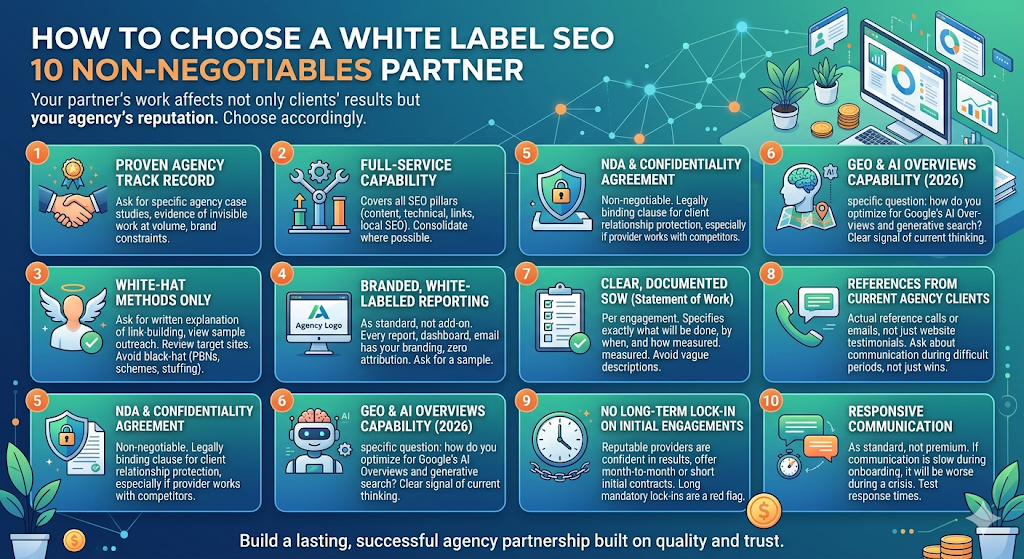
Your white label provider’s work affects not only your clients’ results — it affects your agency’s reputation. Every deliverable carries your name. Choose accordingly.
- Proven track record with agencies specifically. Ask for case studies from agency partners, not just end-client case studies. The operational model is different. You need evidence that they can work invisibly, at volume, within your brand constraints.
- Full-service capability across all SEO pillars. If a provider excels at content but lacks technical depth, or builds links but cannot handle local SEO, you will need to manage multiple vendors. Consolidate where possible — fragmented execution leads to strategic incoherence.
- White-hat methods only, verifiable. Ask for a written explanation of their link-building methodology. Request sample outreach emails. Review the types of sites they target for link placement. Black-hat tactics — PBNs, link schemes, keyword stuffing — can result in client penalties that destroy both the client’s traffic and your agency’s reputation.
- Branded, white-labeled reporting as standard. Not as an add-on. Every report, dashboard, and email should carry your agency’s branding with zero provider attribution. Ask to see a sample report before signing.
- NDA and confidentiality agreement in place. Non-negotiable. Without a legally binding confidentiality clause, your client relationships have no contractual protection if the provider is also working with your competitors.
- GEO and AI Overviews capability in 2026. Ask the specific question: how do you optimize content for Google’s AI Overviews and generative search platforms? This is the clearest signal of whether a provider’s thinking is current.
- Clear, documented SOW for every engagement. Vague deliverable descriptions lead to scope disputes and missed expectations. Insist on a written statement of work per client that specifies exactly what will be done, by when, and how it will be measured.
- References from current agency clients. Not testimonials on their website — actual reference calls or emails with agencies using the service right now. Ask those agencies specifically about communication during difficult periods, not just during wins.
- No long-term lock-in on initial engagements. A reputable provider is confident enough in their results to offer month-to-month terms or a short initial contract period. Long mandatory lock-ins on a new relationship are a red flag.
- Responsive communication is standard, not premium. If communication is slow during onboarding, it will be worse during a client crisis. Test response times before you sign. Send a pre-sales question and note how long it takes to receive a substantive, informed reply.
Risks and Red Flags to Avoid
White label SEO is not risk-free. The most common failures are preventable — but only if you know what to look for before you sign.
- Black-hat link building — PBN links, paid links disguised as editorial, link schemes. If discovered by Google, the penalty lands on your client’s site, not the provider’s.
- AI-generated content without editorial oversight — Generic AI filler is increasingly caught and penalized by Google’s quality systems. E-E-A-T requires demonstrable human expertise, not volume output.
- No written SOW or vague deliverables — “We’ll do SEO for your client” is not a scope of work. Insist on specificity: what tasks, what volume, what timeline, what metrics define success.
- Quality drift over time — Many providers excel in month one and coast in months three through six. Build performance reviews into your contract, including the right to request work samples and analyst access.
- Over-reliance on a single provider — If your entire SEO revenue runs through one vendor, a provider failure, acquisition, or quality drop creates a catastrophic gap. Qualify a backup provider before you need one.
- No GEO or AI search awareness — A provider still building purely for blue-link rankings is optimizing for a declining share of search visibility. As of 2026, AI Overviews coverage is non-optional for competitive clients.
- Slow communication or opaque reporting — If you cannot explain what the provider did last month to your client, your client will eventually notice. Demand monthly reporting that you actually understand and can present confidently.
- Unusually low pricing without explanation — A provider offering full-service SEO for $200/month is cutting corners somewhere. The only question is where: content quality, link quality, or strategic oversight. Usually all three.
Ethical note
White labeling itself is not the risk — what you white-label is. Reselling poor-quality or black-hat SEO under your brand name is your liability, not the provider’s. You are the one who signed the client contract. Vet providers accordingly.
What Good White Label Reporting Looks Like
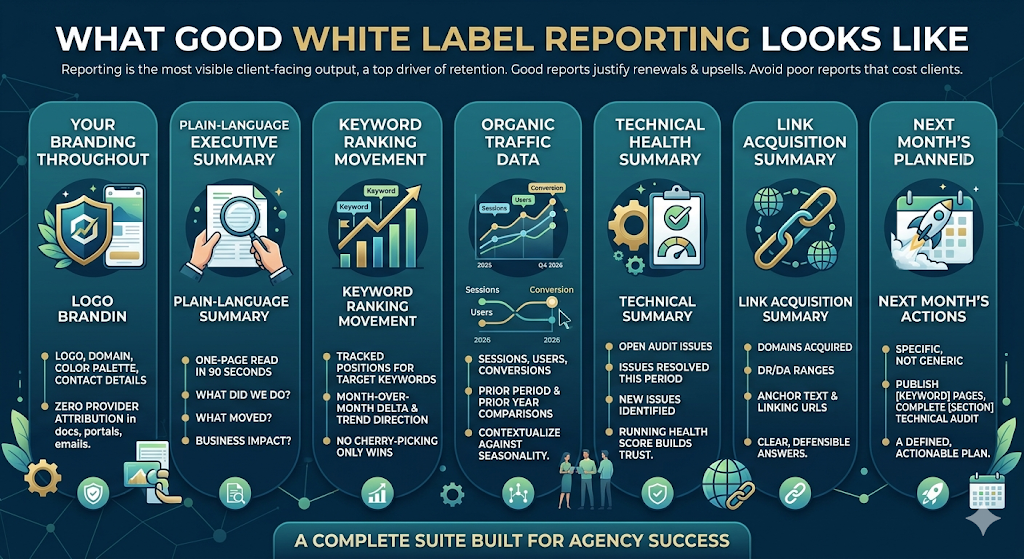
Reporting is the most visible client-facing output your white-label provider produces. It is also the #1 driver of client retention — or churn. Poor reports cost clients. Good reports justify renewals and upsells.
What to demand from a provider’s branded reporting suite:
- Your branding throughout — logo, domain, color palette, contact details. Zero provider attribution anywhere in the document, portal, or accompanying emails.
- Plain-language executive summary — one page a client can read in 90 seconds that answers: what did we do this month, what moved, and what does it mean for their business?
- Keyword ranking movement — tracked positions for agreed target keywords, with month-over-month delta and trend direction. Avoid ranking reports that cherry-pick only the wins.
- Organic traffic data — sessions, users, and conversion events from organic search, compared against the prior period and prior year. Contextualize against seasonality.
- Technical health summary — open issues from the last audit, issues resolved this period, and new issues identified. A running health score over time builds trust.
- Link acquisition summary — domains acquired this period, DR/DA ranges, anchor text, linking page URLs. Any client who asks “where are those links?” should get a clear, defensible answer.
- Next month’s planned actions — specific, not generic. “We’ll continue optimizing keywords” is not a plan. “We will publish three new pages targeting [keyword cluster] and complete the technical audit for [site section].”
Client retention insight
The agencies with the lowest white-label SEO client churn rates are those that send reports proactively — before clients ask — and include a one-paragraph plain-English summary written in the client’s language, not SEO jargon. The provider delivers the data; your agency adds the narrative. That narrative is where client relationships are built or lost.
Keyword Opportunity Map
The following table maps the core keyword cluster around white label SEO, organized by search intent and estimated monthly volume. Use this as a content planning roadmap — each row is a potential article, section, or FAQ answer.
| How to choose white label SEO partner | Intent | Vol/mo | Difficulty |
|---|---|---|---|
| what is white label SEO | Informational | 4,400 | Medium |
| how does white label SEO work | Informational | 880 | Low |
| white label SEO services | Commercial | 2,900 | Medium |
| white label SEO pricing | Commercial | 880 | Low |
| white label SEO reseller | Commercial | 1,600 | Low |
| how to choose white label SEO partner | Informational | 590 | Low |
| SEO outsourcing for agencies | Commercial | 720 | Low |
| white label SEO reports | Commercial | 480 | Low |
| white label SEO vs in-house SEO | Informational | 210 | Low |
| GEO generative engine optimization SEO | Informational | 290 | Low |
| white label local SEO | Commercial | 260 | Low |
| white label SEO risks | Informational | 170 | Low |
| white label SEO for small agencies | Informational | 320 | Low |
| white label SEO agency markup | Commercial | 190 | Low |
| private label SEO | Informational | 390 | Low |
Frequently Asked Questions
These five questions reflect the current People Also Ask box for “what is white label SEO” — each answer is structured for featured snippet eligibility. What is white-label SEO? ▾
White label SEO is a business arrangement where a specialist SEO provider delivers search optimization services that another company — typically a digital marketing agency — rebrands and resells under its own name. The end client never knows a third party is involved. The agency manages the client relationship and billing; the provider executes the technical SEO work, including audits, content, link building, and reporting. How much does white-label SEO cost per month in 2026? ▾
White label SEO wholesale pricing in 2026 ranges from roughly $300–$800/month for entry-level retainers (basic on-page and reporting) up to $3,000–$5,000+/month for full-service engagements including technical SEO, content, link building, local SEO, and GEO/AI Overviews optimization. Agencies typically apply a 100–150% markup on wholesale cost when billing clients at retail rates. Is white-label SEO ethical and legal? ▾
Yes. White label SEO is entirely ethical and legal, provided the work follows Google’s Search Quality Evaluator Guidelines. Google does not penalize a site because its SEO was outsourced — it only evaluates the quality and integrity of the work itself. The overwhelming majority of large agencies and brands outsource at least some portion of their SEO delivery. The model becomes problematic only when providers use black-hat tactics — and that responsibility falls on the agency to vet before signing. What is the difference between white label SEO and reseller SEO? ▾
The terms are often used interchangeably, but there is a subtle distinction. White label SEO refers specifically to work delivered with all provider branding removed — every deliverable appears under your agency’s name. Reseller SEO is a broader term that may include arrangements where some provider attribution is still visible. For professional client-facing use, white label (complete rebranding) is the standard. If you are uncertain which model a provider offers, ask directly: “Will your name appear anywhere on any client-facing deliverable?” Who should use white-label SEO? ▾
White label SEO is ideal for: digital marketing agencies wanting to add or expand SEO without the cost of hiring in-house; web design studios that build sites but lack an organic growth offering; PPC agencies diversifying into organic channels; PR firms adding digital visibility services; social media agencies extending into search; and freelance consultants who manage client relationships but want to offer enterprise-level SEO execution beyond what one person can deliver alone.
Sources: Glassdoor SEO Specialist Salary data, March 2026 · SHRM Talent Acquisition Benchmarking Report · Market Research Future Local SEO Software Market Report · ALMcorp SEO Services Market Size Estimate, 2026 · Webfoundr White Label SEO Services Guide, 2026 · Searchandrank White Label SEO Guide, February 2026
Last reviewed: April 2026. All salary and market size figures reflect the most current available data at the time of publication.